VCE · Topic explainer
What is the impulse formula?
Net impulse equals change in momentum, J = Δp. For a constant-mass object, use J = m(v − u). If you know the average net force and its duration, use J = FavgΔt. On a force–time graph, net impulse is the signed area under the net-force curve.
Worked example
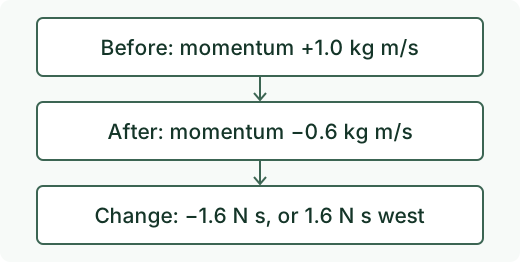
Take east as positive. A 0.20 kg ball travels east at 5 m/s and rebounds west at 3 m/s. Its initial velocity is +5 m/s and its final velocity is −3 m/s.
The net impulse is 0.20 × (−3 − 5) = −1.6 N s, or 1.6 N s west. If contact lasts 0.040 s, the average net force during that interval is −1.6 ÷ 0.040 = −40 N. Keep the signs until you state the direction.
Official exam practice
Find other years and marking guidance in the Physics official exam archive.