Helping Hand Sale · half price until 17 November — the end of exams
Choose your subject plan.
Pick 1, 3 or 5 subjects. One payment for subject access.
5 subjects
5-Subject Mastery Bundle
Choose 5 subjects. Each includes the same complete set of study resources.
Unlock 5 subjects — $60 onceOne payment in AUD. No subscription.
Access for as long as ATARMAxxing operates.
No account needed to pay.
3 subjects
3-Subject Mastery Bundle
Choose 3 subjects. Each includes the same complete set of study resources.
Unlock 3 subjects — $50 onceOne payment in AUD. No subscription.
Access for as long as ATARMAxxing operates.
No account needed to pay.
1 subject
1-Subject Mastery Pack
Notes, exams, worked questions and flashcards for the subject you choose.
Unlock 1 subject — $20 onceOne payment in AUD. No subscription.
Access for as long as ATARMAxxing operates.
No account needed to pay.
Preview every subject before you pay — a sample note, a worked question and the full contents list, no card needed.
Need help choosing? Read the parent guide or contact us.
Preview first. Contact us if something is wrong.
Preview a subject before you pay — a sample note, a worked exam question and the full contents list, no card, no account. If you unlock a hub and it isn't what this page described, email hello@atarmaxxing.com.au and we'll refund it. No form, no argument.
We do not guarantee a particular ATAR or result. The material must be exactly what we said it was, or you don't pay for it. Your rights under the Australian Consumer Law apply on top of this and nothing here limits them.
Every Mastery Pack includes
- Original practice exams — with mark-by-mark answer guides
- Complete revision notes — also available free
- Practice questions — fully worked
- 200 flashcards — with spaced repetition built in
- Free links to available official past papers + marking guides
- Reveal-answer mode — sit it, then mark it
Browse every subject and preview what's inside for free, no card required — you only pay when you're ready to unlock the full hub, and you only pay once.
From the resource library
See what you’ll be studying.
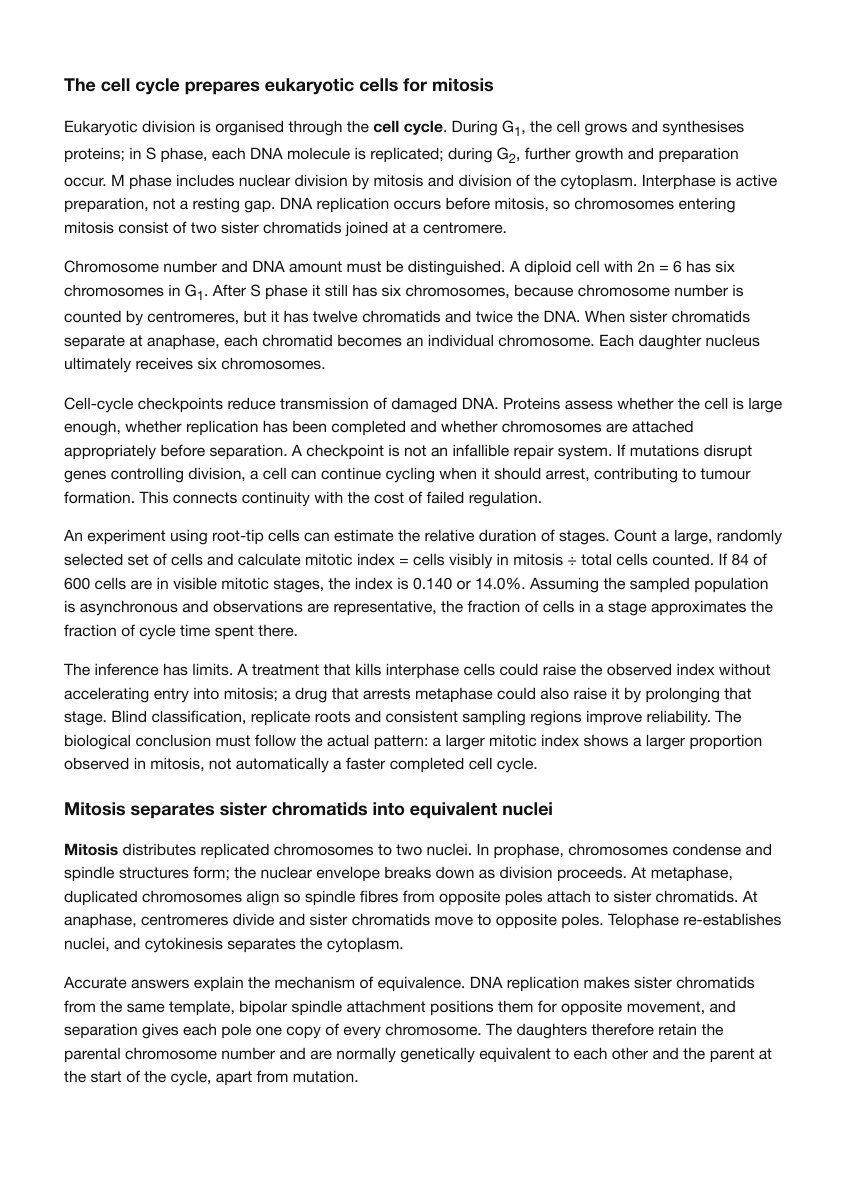
These are pages from the WACE Biology revision notes. Each subject has its own notes, organised into topics so you can find the part you need.
Browse a subject’s sample notes and worked question, or choose a free PDF to keep.
Explore BiologyChoose your free notes →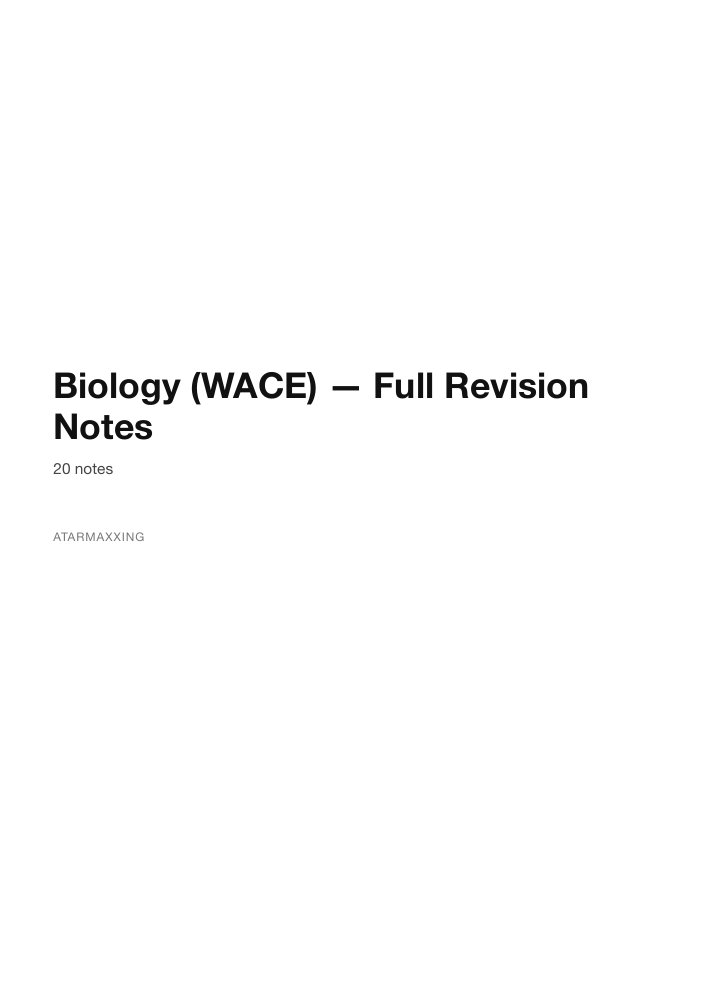
Read a sample note
This note comes from the VCE Chemistry hub. Open the subject to read the full sample and try a worked exam question before choosing a plan.
Energy Calculations: Stoichiometry of Fuels Read sample
1. Begin With a Balanced Equation: Mole Ratios in Combustion
Every energy question on the VCE paper, no matter how elaborate, starts with a balanced combustion equation. The coefficients are not decoration — they are the mole ratios that connect the amount of fuel burnt to the oxygen consumed, the carbon dioxide released and, through ΔH, the energy supplied. An unbalanced equation poisons every step that follows, so this is worth ten seconds of care every single time.
For any hydrocarbon burning completely in plentiful oxygen, the only products are CO2 and H2O. Balance in the order carbon, then hydrogen, then oxygen — oxygen last, because O2 stands alone and can absorb any coefficient. If oxygen lands on a half, double the whole equation:
- CH4 + 2O2 → CO2 + 2H2O (natural gas)
- C3H8 + 5O2 → 3CO2 + 4H2O (LPG)
- 2C8H18 + 25O2 → 16CO2 + 18H2O (octane in petrol — doubled to clear the half)
- C2H5OH + 3O2 → 2CO2 + 3H2O (ethanol — count the oxygen the fuel brings with it)
In incomplete combustion (restricted oxygen supply) the carbon ends up as CO and/or solid carbon (soot), e.g. 2CH4 + 3O2 → 2CO + 4H2O. This releases less energy per mole of fuel and produces toxic carbon monoxide — a classic one-mark explanation. The conversion rule for every ratio problem is: n(target) = n(known) × (coefficient of target ÷ coefficient of known).
Worked example. A patio heater burns 11.0 g of propane completely. Find the mass of oxygen consumed and of carbon dioxide produced.
- Step 1 — equation: C3H8 + 5O2 → 3CO2 + 4H2O.
- Step 2 — moles of fuel: M(C3H8) = 3 × 12.0 + 8 × 1.0 = 44.0 g/mol, so n(C3H8) = 11.0 ÷ 44.0 = 0.250 mol.
- Step 3 — apply ratios: n(O2) = 0.250 × 5 = 1.25 mol, so m(O2) = 1.25 × 32.0 = 40.0 g. n(CO2) = 0.250 × 3 = 0.750 mol, so m(CO2) = 0.750 × 44.0 = 33.0 g.
- Step 4 — sanity check: n(H2O) = 0.250 × 4 = 1.00 mol = 18.0 g. Mass in = 11.0 + 40.0 = 51.0 g; mass out = 33.0 + 18.0 = 51.0 g. Conservation of mass holds, so the working is internally consistent.
Spot the trap: M(CO2) = 44.0 g/mol happens to equal M(C3H8). They are different substances — label every line of working so you never divide by the wrong 44.0.
2. Turning ΔH Into Numbers: Mass–Energy Calculations
A thermochemical equation is a balanced equation with states shown and an enthalpy change attached: CH4(g) + 2O2(g) → CO2(g) + 2H2O(l), ΔH = -890 kJ/mol. The negative sign says the reaction is exothermic; the magnitude says 890 kJ leaves the system for the molar amounts exactly as written. Because methane's coefficient is 1, that is 890 kJ per mole of CH4 — but double the equation and ΔH doubles with it: 2CH4(g) + 4O2(g) → 2CO2(g) + 4H2O(l), ΔH = -1780 kJ/mol. ΔH belongs to the equation, not to any single substance.
The data book lists heats of combustion two ways, and you should hop between them with kJ/g = (kJ/mol) ÷ M. Typical data-book-style values (complete combustion at SLC forming H2O(l); always read the current data book rather than trusting memory):
| Fuel | Heat of combustion (kJ/mol) | M (g/mol) | Heat of combustion (kJ/g) |
|---|---|---|---|
| Hydrogen, H2 | 286 | 2.0 | 143 |
| Methane, CH4 | 890 | 16.0 | 55.6 |
| Ethanol, C2H5OH | 1360 | 46.0 | 29.6 |
| Octane, C8H18 | 5460 | 114.0 | 47.9 |
The master relationship for mass–energy questions is energy released = n(fuel) × molar heat of combustion, with n = m ÷ M. Run it forwards (mass → energy) or backwards (energy → mass).
Worked example (backwards). What minimum mass of ethanol must be burnt to release 500 kJ?
- Step 1: n(C2H5OH) = energy ÷ heat of combustion = 500 ÷ 1360 = 0.3676 mol (keep guard digits in the calculator).
- Step 2: M(C2H5OH) = 2 × 12.0 + 6 × 1.0 + 16.0 = 46.0 g/mol.
- Step 3: m = 0.3676 × 46.0 = 16.9 g (3 significant figures).
Worked example (forwards). Energy from a 250 g tank of octane: n = 250 ÷ 114.0 = 2.193 mol; energy = 2.193 × 5460 = 11 974 kJ, which rounds to 1.20 × 10,000 kJ — report it as 12.0 MJ. Note the unit discipline: combustion data arrive in kJ, while q = mcΔT (coming up) produces joules. Convert one of them before they ever meet on the same line.
3. Gas Volumes at SLC: Making 24.8 L/mol Work for You
SLC (standard laboratory conditions) means 25°C and 100 kPa — the reference conditions for gas calculations in Units 3&4. At SLC, one mole of any gas occupies 24.8 L: the molar volume, Vm, supplied in the data book. The two working equations are n = V ÷ 24.8 and V = n × 24.8. Under the current study design, gas-volume calculations are done at SLC with this value — there is no general gas equation to juggle.
Two guardrails before you touch the calculator:
- Only gases get 24.8 L/mol. At 25°C, water is a liquid — never report a "volume of water vapour at SLC" via molar volume. Octane and ethanol are liquids at SLC too. Check the state of every species before converting.
- Gas-to-gas shortcut: at the same temperature and pressure, the volume ratio of gases equals the mole ratio, because equal volumes contain equal numbers of particles. For volume–volume questions you can skip moles entirely.
Worked example A (volume–volume). A cooktop burns 5.00 L of methane, measured at SLC. What volumes of oxygen are consumed and carbon dioxide produced at the same conditions? From CH4 + 2O2 → CO2 + 2H2O: V(O2) = 2 × 5.00 = 10.0 L and V(CO2) = 1 × 5.00 = 5.00 L. No mole step needed — the ratios do all the work.
Worked example B (mass–volume). What volume of CO2, at SLC, is released by complete combustion of 11.4 g of octane?
- Step 1 — equation: 2C8H18 + 25O2 → 16CO2 + 18H2O.
- Step 2 — moles of fuel: M(C8H18) = 8 × 12.0 + 18 × 1.0 = 114.0 g/mol, so n = 11.4 ÷ 114.0 = 0.100 mol.
- Step 3 — ratio: CO2 : octane = 16 : 2 = 8 : 1, so n(CO2) = 8 × 0.100 = 0.800 mol.
- Step 4 — volume: V = 0.800 × 24.8 = 19.8 L at SLC.
Extension check: the oxygen demand is n(O2) = 0.100 × (25 ÷ 2) = 1.25 mol, or 31.0 L at SLC. A tablespoon-sized splash of petrol consumes over thirty litres of oxygen gas — which is exactly why engines need a constant air intake, and why restricting that intake tips combustion from complete to incomplete.
4. Percentage Efficiency: Accounting for Lost Energy
Real devices never deliver all of a fuel's chemical energy where you want it. Heat escapes to the container, the surrounding air and the apparatus; combustion may be incomplete; some energy radiates away as light. Percentage efficiency compares what you got with what the fuel offered:
% efficiency = (useful energy output ÷ total energy input) × 100
In fuel questions the useful output is almost always heat absorbed by water, found with q = mcΔT — m is the mass of the water in grams, c = 4.18 J/(g·°C) for water, ΔT in °C, and q comes out in joules. The total input is the combustion energy, n(fuel) × heat of combustion, in kilojoules. Convert joules to kilojoules before the two meet.
Efficiency problems run in two directions, and the second is where marks die:
- Finding efficiency: calculate both energies, then divide useful by total and multiply by 100.
- Finding fuel needed at a stated efficiency: the fuel must release more energy than the water absorbs, so divide: energy from fuel = energy to water ÷ (efficiency ÷ 100). If your fuel mass comes out smaller than the 100%-efficient answer, you multiplied when you should have divided.
Worked example. A camping stove burning butane (heat of combustion 2880 kJ/mol; M = 58.0 g/mol) heats 1.50 kg of water from 18.0°C to boiling at 100.0°C. Only 45.0% of the energy released reaches the water. What mass of butane is burnt?
- Step 1 — useful energy: q = mcΔT = 1500 × 4.18 × (100.0 - 18.0) = 1500 × 4.18 × 82.0 = 514 140 J = 514.1 kJ.
- Step 2 — total energy required: 514.1 ÷ 0.450 = 1142.5 kJ (the stove must release far more than the water receives).
- Step 3 — moles of butane: n = 1142.5 ÷ 2880 = 0.3967 mol.
- Step 4 — mass: m = 0.3967 × 58.0 = 23.0 g.
Sanity check: 23.0 g is about a tenth of a small 220 g gas canister to boil a generous billy at poor efficiency — believable. This is also the logic behind calorimeter calibration in the lab: a calibration factor folds the heat losses of that particular apparatus into one constant. A calibration factor is essentially efficiency wearing a lab coat.
5. Comparing Fuels Fairly: kJ per Gram and CO2 per Megajoule
"Which fuel is better?" is only answerable once you fix the basis of comparison. Comparing kJ per mole flatters big molecules — octane "beats" hydrogen per mole simply because each molecule carries more atoms — so examiners expect two fairer measures:
- Energy density (kJ/g): energy per gram of fuel, found from kJ/g = (kJ/mol) ÷ M. Critical for transport fuels, because every gram must be carried.
- CO2 per megajoule (g/MJ): mass of CO2 emitted per MJ of energy delivered — the greenhouse comparison. Find moles of fuel per 1000 kJ, apply the CO2 mole ratio, convert to grams.
| Fuel | Complete combustion equation | Heat of combustion (kJ per mol fuel) | Energy density (kJ/g) | CO2 emitted (g per MJ) |
|---|---|---|---|---|
| Hydrogen | 2H2 + O2 → 2H2O | 286 | 143 | 0 |
| Methane | CH4 + 2O2 → CO2 + 2H2O | 890 | 55.6 | 49.4 |
| Octane (petrol) | 2C8H18 + 25O2 → 16CO2 + 18H2O | 5460 | 47.9 | 64.5 |
| Ethanol | C2H5OH + 3O2 → 2CO2 + 3H2O | 1360 | 29.6 | 64.7 |
Worked example — deriving the last column for methane and octane. Per MJ (1000 kJ) of energy: n(CH4) = 1000 ÷ 890 = 1.124 mol; the equation gives 1 mol CO2 per mol CH4, so m(CO2) = 1.124 × 44.0 = 49.4 g/MJ. For octane: n(C8H18) = 1000 ÷ 5460 = 0.1832 mol; the 8 : 1 ratio gives n(CO2) = 1.465 mol, so m(CO2) = 1.465 × 44.0 = 64.5 g/MJ. Methane is the lowest-emitting fossil fuel per joule because of its high hydrogen-to-carbon ratio — much of its energy comes from forming water rather than CO2.
Interpretation lines examiners reward:
- Ethanol vs petrol: nearly identical CO2 at the exhaust per MJ (64.7 vs 64.5 g), but bioethanol's carbon was recently captured from the atmosphere by photosynthesis, so its net contribution is much lower — not zero, since farming, fertiliser and distillation consume energy. Its weakness is energy density: 1 MJ needs 1000 ÷ 29.6 = 33.8 g of ethanol but only 1000 ÷ 47.9 = 20.9 g of octane, about 1.6 times the fuel mass for the same trip.
- Hydrogen: spectacular per gram (143 kJ/g) and zero CO2 at the point of use, but as a gas it stores poorly per litre, and its green credentials depend on its source — green hydrogen from electrolysis powered by renewables versus hydrogen made by steam reforming of methane, which still releases CO2.
Always state the basis ("per gram", "per MJ") in written answers; an unqualified "ethanol releases less energy" earns nothing.
6. Multi-Step Mastery: A Full Exam-Style Problem
Section B loves chaining four ideas into a single 5–7 mark question. The reliable route map:
- 1. Equation first: balanced, with states whenever energy is involved.
- 2. Convert in: everything to moles — n = m ÷ M for masses, n = V ÷ 24.8 for gases at SLC, n = energy ÷ heat of combustion if energy is the given.
- 3. Ride the ratio: coefficients convert moles of one species into moles of another.
- 4. Convert out: to mass (× M), to gas volume (× 24.8), or to energy (× heat of combustion).
- 5. Apply efficiency at the energy step: divide by the efficiency fraction when finding fuel required; multiply when finding what the water actually receives.
- 6. Round once: keep four digits in working, then give 3 significant figures with units, using "releases/absorbs" rather than a sign.
Capstone worked example. A spirit burner containing ethanol heats 500 g of water in a beaker from 21.5°C to 85.5°C. Energy transfer to the water is 70.0% efficient. The heat of combustion of ethanol is 1360 kJ/mol. (a) How much energy does the water absorb? (b) What mass of ethanol is burnt? (c) What volume of CO2, measured at SLC, is released?
- (a) ΔT = 85.5 - 21.5 = 64.0°C. q = mcΔT = 500 × 4.18 × 64.0 = 133 760 J = 133.8 kJ ≈ 134 kJ.
- (b) Energy the fuel must release = 133.76 ÷ 0.700 = 191.1 kJ. n(C2H5OH) = 191.1 ÷ 1360 = 0.1405 mol. m = 0.1405 × 46.0 = 6.46 g.
- (c) C2H5OH + 3O2 → 2CO2 + 3H2O, so n(CO2) = 2 × 0.1405 = 0.2810 mol. V = 0.2810 × 24.8 = 6.97 L at SLC.
Audit the answer the way a marker would: 6.46 g of ethanol is roughly 8 mL — a believable splash for near-boiling water — and the CO2 volume (about 7 L) dwarfs the liquid fuel volume because gases at SLC are around a thousand times less dense than liquids. Two marking-scheme habits pay for themselves: carry unrounded values through the calculator and round only on the final line; and finish with a sentence plus units — "6.46 g of ethanol is required" — because transcription slips between working and answer line cost real marks every year. If a part (d) asks for an assumption, offer: combustion is complete, all losses are captured in the 70.0% figure, or the solution's specific heat capacity is taken as that of pure water.
Questions, answered
Is this really a one-off payment?
Yes. You pay once and the subjects you unlock stay unlocked — there is no subscription, no renewal and nothing to cancel. We don't keep a card on file to bill you again.
What does "lifetime" mean exactly?
Access for as long as ATARMAxxing operates, with no time limit on your account and no repeat charges. If the platform ever had to close, our Terms commit us to at least 60 days' notice so you can download what you need. The full definition is in our Terms & Conditions.
Can I change which subjects I pick?
Yes — you can swap a subject once within 14 days of buying, just email us. After that a slot stays with the subject you chose. And you can preview every subject — a sample note, a worked exam question and the full contents list — before you spend anything, to help you choose. To study more subjects, another purchase adds the number of subject slots you buy to your account.
Can I get a refund?
If a hub isn't what this page said it was, email hello@atarmaxxing.com.au and we'll refund it. No form and no argument. That is your right under the Australian Consumer Law and nothing here limits it. Because you can preview every subject before paying, we do ask that you look first.
Is this affiliated with the VCAA, NESA or QCAA?
No. ATARMAxxing is independent. Our materials are original study resources written to the public VCE study designs, NSW HSC (NESA Stage 6) syllabuses and QCAA General syllabuses; nothing here is official or authoritative.
What's the difference between the tiers?
Only how many subjects you unlock — 1, 3 or 5. Every subject includes its complete digital Mastery Pack.
By purchasing you agree to our Terms & Conditions. Who you are paying, how the preview works and our refund terms are on the About page.