VCE · Topic explainer
What is elastic potential energy?
Elastic potential energy is energy stored when an object is deformed elastically. For a spring that obeys Hooke’s law, the energy stored relative to its natural length is E = ½kx². Here k is the spring constant and x is the extension or compression in metres.
Worked example
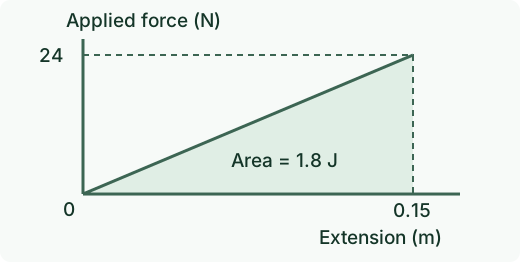
An ideal spring has a spring constant of 160 N/m and is stretched 0.15 m from its natural length. The applied force increases from zero to 24 N as it stretches. The work done is the area of the triangle under the force–extension graph.
The energy stored is ½ × 160 × 0.15² = 1.8 J. Stretching the same ideal spring twice as far stores four times as much energy, provided the spring still obeys Hooke’s law.
Official exam practice
Find other years and marking guidance in the Physics official exam archive.