VCE · Topic explainer
How do AC and DC differ?
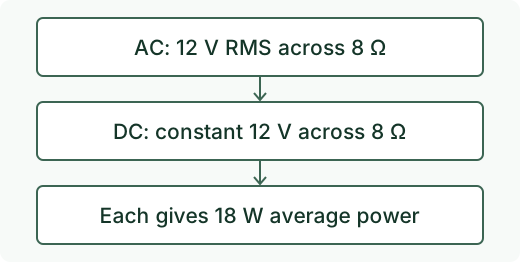
Alternating current reverses direction periodically. Direct current flows in one direction. For a fixed resistor, an alternating voltage with a given RMS value produces the same average heating power as a steady DC voltage of that value. For a sinusoidal AC voltage, divide the peak voltage by √2 to find its RMS value.
Worked example
A resistor of 8 Ω is connected to a sinusoidal supply with RMS voltage 12 V. Its average power is 12² ÷ 8 = 18 W. A steady 12 V DC supply gives the same power in that resistor.
The sinusoidal AC voltage has a peak of 12√2 V, about 17.0 V. Its average over a complete cycle is zero, while its RMS value is 12 V. RMS captures the heating effect because instantaneous power depends on the square of the voltage.
Official exam practice
Find other years and marking guidance in the Physics official exam archive.