VCE · Topic explainer
How does the simple interest formula work?
Simple interest is calculated on the starting principal. Use I = Prt, where P is the principal, r is the interest rate per time period as a decimal and t is the number of matching periods. Add the interest to the principal to find the total balance, assuming there are no fees or other transactions.
Worked example
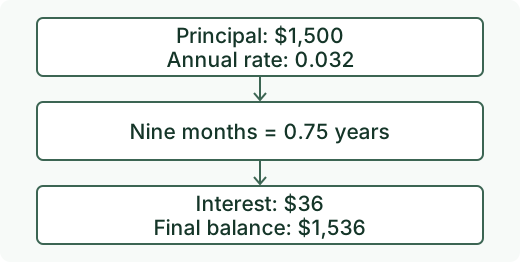
A saver puts $1,500 into an account at 3.2% simple interest per year for nine months. Use r = 0.032 and t = 9/12 years. The interest is $1,500 × 0.032 × 0.75 = $36.
The balance is $1,536. A quick check is that the full year would earn $48. Nine months is three quarters of a year, so three quarters of $48 is $36.
Official exam practice
Find other years and marking guidance in the General Mathematics official exam archive.