VCE · Topic explainer
Leslie matrices in VCE General Mathematics
A Leslie matrix models population change across age groups. The top row contains fertility rates and the entries just below the main diagonal contain survival rates into the next age group. Multiply the matrix by a column vector of current group sizes to calculate the population in the next time period.
Worked example
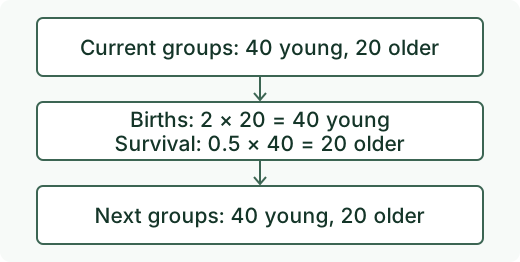
Suppose the current population has 40 younger animals and 20 older animals. Each older animal produces an average of 2 recruits per period, younger animals do not reproduce, and half the younger animals survive to enter the older group. Assume the older group is the final age class and its members leave the model after that period.
Use rows [0, 2] and [0.5, 0] in the Leslie matrix. The first row gives 0 × 40 + 2 × 20 = 40 recruits. The second gives 0.5 × 40 + 0 × 20 = 20 older animals. Keep the same age order in the matrix and in the column vector.
Official exam practice
Find other years and marking guidance in the General Mathematics official exam archive.