VCE · Topic explainer
How to read the periodic table of elements
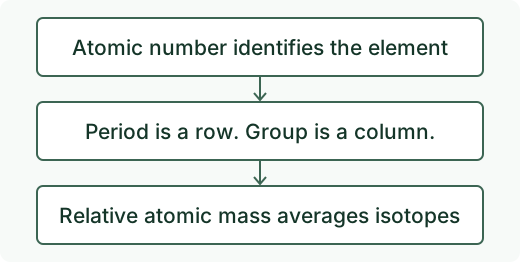
The periodic table arranges elements by atomic number, the number of protons in each atom. Rows are periods and columns are groups. Main-group elements in the same group often react in similar ways. Use the data-book legend to distinguish atomic number from relative atomic mass and to locate electronegativity values.
Worked example
Find chlorine in group 17 and period 3. Its atomic number is 17, so a neutral chlorine atom has 17 protons and 17 electrons. A chloride ion has one additional electron and the same 17 protons.
The relative atomic mass is about 35.5 because the value averages the naturally occurring isotopes by abundance. Use the relative atomic mass for a molar mass calculation, and the atomic number when you need to count protons.
Official exam practice
Find other years and marking guidance in the Chemistry official exam archive.