VCE · Topic explainer
How does a galvanic cell work?
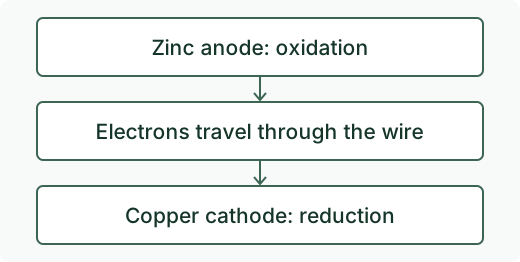
A galvanic cell converts chemical energy into electrical energy through a spontaneous redox reaction. Oxidation at the anode releases electrons. Reduction at the cathode consumes them. Electrons pass through the external circuit, while ions moving through a salt bridge or electrolyte help balance charge.
Worked example
In a zinc–copper galvanic cell, zinc is the negative anode. Zinc metal loses electrons to form zinc ions. Electrons travel through the wire to the positive copper cathode, where copper ions gain electrons and deposit as copper metal.
The salt bridge completes the circuit by carrying ions. Anions migrate toward the zinc half-cell as zinc ions accumulate. Cations migrate toward the copper half-cell as copper ions are consumed. A galvanic element is another name for a galvanic cell.
Official exam practice
Find other years and marking guidance in the Chemistry official exam archive.
Further reading. VCAA current Chemistry teaching guidance