VCE · Topic explainer
How do you use the electrochemical series?
The electrochemical series orders half-reactions by standard reduction potential. For two suitable half-cells under standard conditions, the higher potential is the reduction at the cathode. Reverse the lower-potential half-reaction for oxidation at the anode. Subtract the anode’s listed reduction potential from the cathode’s to predict the standard cell voltage.
Worked example
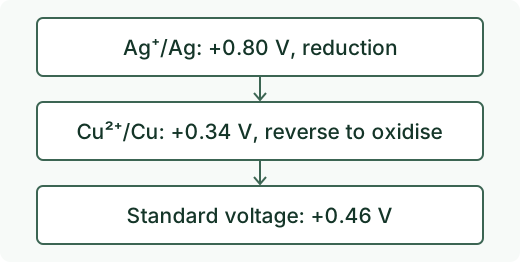
The VCAA data book lists Ag⁺/Ag at +0.80 V and Cu²⁺/Cu at +0.34 V. For a silver–copper cell, silver ions are reduced and copper metal is oxidised. The standard voltage is 0.80 − 0.34 = 0.46 V.
Balance electrons by doubling the silver half-equation. Electrode potential is a voltage, so keep +0.80 V unchanged when you double the equation. The overall reaction is Cu(s) + 2Ag⁺(aq) → Cu²⁺(aq) + 2Ag(s).
Official exam practice
Find other years and marking guidance in the Chemistry official exam archive.
Further reading. VCAA 2025 Chemistry examination and data book, electrochemical series