VCE · Topic explainer
What is a carboxylic acid?
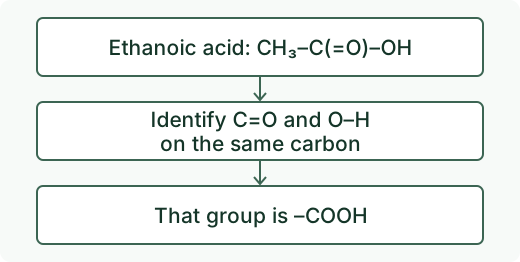
Carboxylic acids contain the carboxyl group, –COOH, with a carbonyl and hydroxyl group on the same carbon. In water, simple carboxylic acids donate a proton and partially ionise. They can also form hydrogen bonds, which helps explain their relatively high boiling points.
Worked example
Ethanoic acid has the condensed formula CH₃COOH. In water, CH₃COOH + H₂O ⇌ CH₃COO⁻ + H₃O⁺. The equilibrium arrow matters because ethanoic acid only partially ionises.
To identify a carboxylic acid on an infrared spectrum, look for the very broad acid O–H absorption together with a strong C=O absorption. An O–H signal alone could come from an alcohol. Check both features before deciding.
Official exam practice
Find other years and marking guidance in the Chemistry official exam archive.