VCE · Topic explainer
The accounting equation in VCE Accounting
The accounting equation is Assets = Liabilities + Owner’s Equity. Assets are the resources controlled by the business. Liabilities are its obligations. Owner’s equity is the residual interest after liabilities are deducted from assets. To analyse a transaction, identify what changes and check that the equation still balances.
Worked example
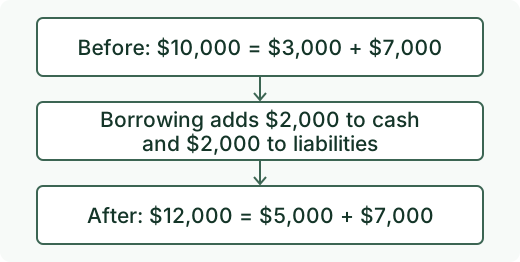
A business starts with $10,000 in assets, $3,000 in liabilities and $7,000 in owner’s equity. It borrows $2,000 from the bank. Cash rises by $2,000 and the loan liability rises by $2,000. Owner’s equity stays at $7,000.
The equation becomes $12,000 = $5,000 + $7,000. Borrowing brings in cash and creates an obligation to repay. For a cash purchase of equipment, one asset increases and another decreases, so the asset total can stay the same.
Official exam practice
Find other years and marking guidance in the Accounting official exam archive.
Further reading. VCAA current Unit 3 assessment advice