HSC · Topic explainer
How do you find the volume of a pyramid?
A pyramid’s volume is one third of its base area multiplied by its perpendicular height. For a square base with side length s, use V = s²h/3. Find the vertical height from the base plane to the apex. Use consistent units and give the result in cubic units.
Worked example
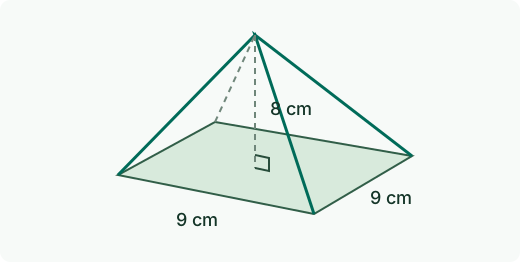
A square-based pyramid has a side length of 9 cm and a perpendicular height of 8 cm. Its base area is 9 × 9 = 81 cm². The volume is 81 × 8 ÷ 3 = 216 cm³.
If you know the volume and need the height, multiply by 3 and divide by the base area. When objects sit inside a pyramid, add their volumes to the empty space to recover the full volume before rearranging the formula.
Official exam practice
Find other years and marking guidance in the Mathematics Standard 2 official exam archive.