HSC · Topic explainer
How do you calculate absolute error?
In HSC Mathematics Standard, a measurement rounded to the nearest unit can differ from the original value by up to half that unit. To find this rounding error bound, halve the measurement precision. When an accepted value is supplied, the actual absolute error is the magnitude of the measured value minus that reference.
Worked example
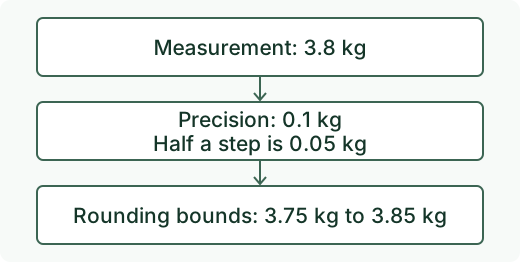
A parcel is measured as 3.8 kg to the nearest 0.1 kg. Half of 0.1 kg is 0.05 kg, so the rounding bounds are 3.75 kg and 3.85 kg.
If an accepted reference value is 3.82 kg, the actual absolute error for this reading is |3.8 − 3.82| = 0.02 kg. The bound describes what rounding permits. The actual error compares the reading to a supplied reference.
Official exam practice
Find other years and marking guidance in the Mathematics Standard 2 official exam archive.