HSC · Topic explainer
How does the normal distribution work?
The normal distribution is a continuous, bell-shaped model with its centre at the mean. The standard deviation controls its spread. Convert a value x to a z-score with z = (x − mean) ÷ standard deviation. To find the proportion above a value, use the area to its right.
Worked example
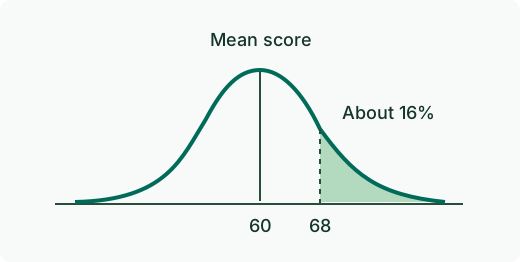
Suppose scores have mean 60 and standard deviation 8. A score of 68 is one standard deviation above the mean, so z = (68 − 60) ÷ 8 = 1.
About 68% of a normal distribution lies within one standard deviation. The two tails share the remaining 32% equally, so about 16% is above 68. A normal calculation gives about 15.9%. For 200 people, the expected count is approximately 32.
Official exam practice
Find other years and marking guidance in the Mathematics Advanced official exam archive.