HSC · Topic explainer
Calculating percentage yield with a limiting reagent
Percentage yield is actual yield divided by theoretical yield, multiplied by 100. Find theoretical yield from the limiting reagent and the balanced equation. Convert the measured product to the same unit as the theoretical yield before taking the ratio.
Worked example
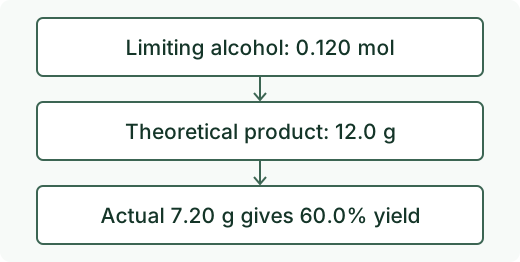
Two reactants form an ester in a 1:1 ratio. Start with 0.120 mol of alcohol and 0.150 mol of acid. The alcohol limits the reaction, so the theoretical ester yield is 0.120 mol. At a molar mass of 100 g/mol, that corresponds to 12.0 g.
Suppose 8.00 mL of ester is collected and its density is 0.900 g/mL. Its actual mass is 7.20 g. Divide 7.20 by 12.0 and multiply by 100 to obtain 60.0%.
Official exam practice
Find other years and marking guidance in the Chemistry official exam archive.